Showing posts sorted by relevance for query dividend yield. Sort by date Show all posts

Wednesday, June 01, 2011

"How, Oh How, Is the Economy Not Recovering?"

I love stories like this where the "professionals of Wall Street" (remember those guys, the ones that headed up elite investment banks like Bear Stearns and Lehman Brothers) are "shocked, shocked" the economy hasn't recovered yet. What I love more is when they put the cart before the horse, driving up stock prices FIRST, presuming economic growth will follow. And then, perhaps the greatest quote in the entire article is:

"With these kind of dividend yields, these stocks are a steal!"

So once again it seems high time to me to explain the "dividend yield" and provide an important lesson in this fascinating ratio.

The dividend yield is the dividends of a stock divided by the price of a stock. In short it shows you the percent return you can expect to receive from dividends. So for example if a stock pays a $1 dividend per share and it's currently trading at $10, your dividend yield is 10%.

Most people scoff at dividends because they invest in stocks "because they will hopefully go up in the future." This increase in the stock price is called a capital gain. And while they provide the basis for millions of people's retirements and trillions of invested dollars, the premise of investing in a stock "because it will go up in the future" is flawed and will cause a horrendous problem in the future.

Understand what drives the price of a stock is the earnings or profits the firm makes.

HOWEVER,

you as a shareholder will not see the earnings of the firm. You only get to see the portion of the earnings the firm decides to pay out as it may wish to retain some of those earnings and reinvest them back into the company. This portion they pay out is the dividend.

Now, if you think about it, you will realize that the ONLY thing that really drives the price or value of a stock is the dividends because that is ALL the shareholders see.

Of course some people will say, "Yes, but don't I get SOME money in the future if I sell it?"

Correct, but when you sell it in the future, why did somebody pay you money for your shares? Or a better question, "what did you sell to that person?"

You didn't sell him "something you can sell for more in the future." You sold him a share of stock that will entitle him to the future dividends that stock will pay. That is what gives the stock value. The stock could be sold over and over again, but you are inevitably selling a security that pays out dividends and nothing else.

So are dividends so high and prices so low that they are "a steal" as super intelligent Wall Street investment types say they are?

Well, here you go.


I've pointed this out before, but I shall say it again.

Dividends historically paid out around 5%. Today they are below 2%.

The reason why dividend yields are so low can be explained by reading the post about 3 posts below titled "When You Abandon Fundamental Value."

So my fine loyal readers, take it from the Captain. Right now buying the average S&P 500 stock is like buying something at about 2.5X's more expensive than it traditionally has been. To put it into perspective think of common everyday consumables we buy with the following prices;

A gallon of gas going for $9.75
A Kia Rio going for $25,000
A Big Mac going for $8.75
A movie ticket for $25

That is what (using the dividend yield as a metric for value) buying into the US stock market is like today.

And bar any economic growth (which there is "surprisingly little" of), you can expect reality and efficiency to hit the markets. May not happen today. May not happen tomorrow. But it will happen. And the only thing that is going to give your precious little 401k balances a boost is going to be BOOMING economic growth that can only come from a Austrian economic model ala Ronald Reagan circa 1981 and not this Keynesian nightmare the naivety of the American voting public has wreaked upon us.

Tuesday, March 17, 2015

According to DudeBroWallStreetFratBoys the Stock Market is Never Overvalued

A new generation is upon us and I know this not only because of common sense and basic demographic information, but because there's been a recent spat of college age/20 somethings who have critiqued my earlier work about the stock market being overvalued.  Naturally, my criticisms go back to even before the financial crisis, but this was when most of these finance-majoring DudeBros were all of 10 years old.  And now, equipped the little, microscopic, and misleading information that comes with a degree in finance today, these know it all FinanceMajoringDudeBros are going to set the ole Captain straight about how his predictions have not come true, and that they are going to somehow be smarter and better than their baby boomer and Gen X bailed-out bankster counterparts.

Ahhhhh youth.

So let's beat this dead horse one more time.

There are two measures we use to gauge whether a stock is worth the price.  Price to Earnings (or the "PE" ratio) and the Dividend Yield.

The PE ratio is simply that - the price per share divided by the earnings per share.  It shows you what you are paying in stock price per dollar in earnings.  The higher it is the more overvalued a stock is and vice versa.

The dividend yield is the same concept, except we flip the numerator and denominator AND replace earnings with dividends (because you technically only receive dividends, not the total earnings per share of the company).  Instead of a ratio (like the PE) you get a "yield" or "percent rate of return" on your investment.

And so when we look at both you can PLAINLY see that the market is severely overvalued.


The historical average PE for the S&P 500 has been 15.  It is now trading at 27.  If you are a DudeBroFratBoyGoldmanSachsFutureBailoutRecipient, ask yourself a simple question.  Is it worth paying nearly $800 for the PS4?  Is it worth paying $7/gallon in gas?  And is it worth paying $50,000 for a new AVERAGE sedan?  Because paying a PE of 27 for a share of stock is no different.

The dividend yield is even worse.  The historical average for the dividend yield has been 5%.  You could expect to receive a 5% annual rate of return in the form of dividends.  Today it is 1.8%, a 277% overvaluation.

Now your PS4 costs $1,108.
A new average sedan $69,000.
And a Big Mac $12.50.

Of course, before we pick on future DudeBroFratBoysofAmerica we have to look at ourselves in the mirror.  For while the DudeBroFinanceMajorsofEternalDudeBroness merely parrot what they're told by their charlatans posing as business professors, at least they're not investing in the stock market because they're poor college kids.

The same cannot be said, however, for the millions of obedient, conformist, non-thinking Americans who year after year throw trillions of dollars into their precious 401k and IRA retirement programs.  For they are the financially-illiterate zombies that do not take their advice from the likes of Shiller or Schiff, but the 24 year old HR generalist who "strongly recommends" investing in the company's 401k plan *tee hee!*  And in doing so inflate the stock market beyond all sane and reasonable measures of valuation, not to mention price out younger generations (if they are smart enough to read articles such as these).

The point is that there are three major things driving stock prices higher than their fundamental warrant.

1.  Quantitative Easing

With the Fed printing off money so it can buy treasuries, mortgages, and other unwanted securities off of the banks' hands, the recipient banks of these monies invariably invest said monies in the stock market driving up prices.

2.  Fed-Induced Low Interest Rates

With interest rates very low, it becomes profitable for corporations (ie-shareholders and executives) to borrow at these low rates and repurchase the company's shares.  This drives the value of their shares up more than the interest expense the company would have to pay on its debts.  Of course, this leveraged buyout ignores whether it's worth paying a PE of 27 for its own shares, further fueling the bubble, AND it ignores what would happen if the economy were to tank while they have so much debt on their books, but hey!  We drove the stock price (and thus our stock options) up another 200%, and that's all that matters!

and

3.  Retirement Plans

This is the deadest piece of the horse I've beating since 2004.  Why, oh why, did the government just magically decide it was "the stock market" that would serve as the primary vehicle for 300 million Americans' retirements?

Why not property?
Why not private businesses?

Matter of fact, what business was it of the government's to provide tax incentives for people to invest for retirement anyway?

Pfa!  Who cares, it was "well intended" and that's all that matters.  Distortion of the stock market be damned.

In the end, the same mentality that occurred in 1998 for the DotComs, in 2006 for the housing market, an in 2009-present for the education bubble is reappearing again today in the stock market.

"The market keeps going up!"
"You can't afford NOT to be in this market!"
"You need to save for retirement!"
"What do you mean 'earnings'?"
"What do you mean 'dividends'?"

and my all time favorite

"This time it's different."

And while yes, this time it is different (as the Fed has now made the stock market a place that is a viable long term hedge against inflation, NOT a place to invest in an actual company), let us be clear. It's precisely the exact same shit that happened before.  And the reason it keeps happening so frequently is because the exact same people it happened to before are too damn ignorant and uneducated about economics, not to mention stupid, to learn from their past experiences. 

It drives nearly every real economist in the world to pour a glass of scotch and enjoy the decline.

Wednesday, April 16, 2008

Those Icky, Gross, Yucky Dividends

My buddy Brian is an aspiring economist, and he made quite the astute analogy;

"I'm seeing people treating stocks like baseball cards. They're buying pack after pack of baseball cards trying to find the Mickey Mantle rookie year card, and there's this annoying piece of gum that they throw away. When in reality the only thing of value in that pack of baseball cards is the piece of gum. And people are completely disregarding dividends in the same matter."

He was right, and probably more so than he realizes. For when it gets down to it, the only thing that drives the value of a stock, the only thing that gives a stock its value is dividends, not earnings.

The reason why is that the shareholder never sees all the earnings, only the dividends. The corporation may reinvest profits and only pay out a fraction of that in dividends, but that still doesn't change the fact the only cash flow is dividends.

Now some will argue, "Yeah, but when I sell the stock, I get a capital gains, it's worth more than what I bought it for."

True, but that doesn't change the fact dividends are still what's driving the value of that stock. Whoever buys it from you, is not buying it now in hopes of selling it for more later, they're buying a future string of dividends. In other words, if you held onto the stock, in truth the only thing giving it value is its future dividends.

The only time there is a "genuine" capital gain is when the company is bought out by another. Otherwise the firm either dissolves or goes bankrupt and you have no capital gain. Thus, the entire history and value of a stock is not what profits it made, but what dividends it meted out to its shareholders.

Sadly though, and perhaps through the goggles of retirement planning and 401k's we look at stocks as purely capital gain investments. We rarely care about dividends and presume we'll be able to sell stocks for more when we retire.

There's just one minor problem. The true driver of value for stocks is going down, relative to the price you have to pay. In other words, you have to pay more in stock price to get the same paltry amount of dividends. This is measured by what's called the "dividend yield."

The dividend yield is dividends divided by price. In other words what percent return will you realize from investing in a stock given its price and the dividends it pays.

Roughly the dividend yield has averaged around 5%, meaning you could expect to receive a 5% return in the form of a dividend. Not terribly much, but it was a little more than inflation. But with stock prices being driven by retirement money and less by earnings and even less by dividends, the dividend yield has been driven down below 2% and has been there for the past decade. Even with the stock market crash in 2000 and even with our significant correct today, it's still below 2%.


The reason again is not that dividends have gone down, but prices have gone up so much driving the ratio down. Sadly this little tidbit of data is making me ever more convinced that stocks are going to be coming down like housing once the boomers retire.

Thursday, October 18, 2007

Dividends Ultimately are the Only Thing that Matter

I do a seminar on how to research stocks and one of the first lessons I try to convey to my students is that the reason you invest in a company is NOT the fact that you will try to sell it for more down the road, but that you should really invest in a company for dividends.

For ultimately, that is all a company will ever pay until the point it is either sold or goes bankrupt. Therefore dividends are the only cash flow provided by the company over the course of its life and are therefore the real driver of its value.

So a while ago I had pulled some data to get the average dividend yield for the S&P 500 from Globalfindata.com, and I'm glad I did because they started charging for it when I went to look for an update this morning. Here's my old chart;


Noticed that back in the Great Depression, based on dividend yield stocks were a steal, at one point dividends providing a near 10% of the firm's stock price. But with the nearly 20 year bull market stocks increased at a rate faster than dividends, driving the dividend yield to its historic low of just 1.1%. So roughly, based on the amount of dividends the firm was paying, you'd have to wait almost 100 years to break even.

But that was at the peak of Dotcom Mania and I wondered if the dividend yield, like the S&P 500's P/E ratio had recovered to more normal levels. This required I find more up to date data and found a data series going back to 1927, but then had to supplement it with an old Excel chart I had found (the source of which I did not notate so I don't remember where it came from, but nonetheless I assume it's legit);

And what a whopping recovery. Instead of realizing dividend return of 1.1% you can now expect a full 1.8% return! Seems the market is still partying like it's 1999.

Tuesday, February 05, 2008

How SWPL's Can Predict Bubbles

SWPL (or "Stuff White People Like") when I first read their site I found to be viscerally HILARIOUS. I would just guffaw and heartily so because I found the stuff just so damn funny and so damn accurate. On a deeper level though I didn't really know why it resonated with me so well, but after sitting here at the hospital waiting for a buddy of mine to come out of the urgent care, my super awesome economic genius mind has come up with it.

SWPL exposes the fake, shallow tastes of either faux intellectually elitists or the brain-dead, automotonic herds and delivers to them the mockery and insult they so richly deserve.

For example - "Grad School." HOW GREAT IS THAT? You have some idiot that chose an undergrad degree that was so worthless, they go back for MORE of the same. In reality they are an idiot, BUT, because they have a masters in "fillintheblankhere" they think they're smart.

Or for the "brain-dead herd of lemmings" crowd - Professional sports. Again, how great is that? You have some idiot whose entire LIFE'S WORTH is based on whether or not one group of big guys throws the ball better than another group of big guys, discernible only through the color of the jerseys they wear. But, ohhhhhh wrath upon thee that dare insult the team that these morons have vested so much emotion, psychology and (foolishly) cash into simply because they wear the blue jersey!

But the ultimate kicker for SWPL is that these people are COMPLETELY oblivious to their idiocy. They don't realize they're being made fun of and most of them even think they're smarter than the average person (ever go to a "wine and cheese party?") They just plain don't get the fact that they are the butt of the joke.

Of course there's a problem. SWPL's are not some small group of people. They're the majority of people! And because this is a democracy and a relatively free market we genuinely intelligent people must suffer their idiocy.

For example television.

Um, please somebody explain to me why there are GLEE PARTIES?????

You want TV shows to throw parties over? Try Firefly. Try Cowboy Bebop. Try Venture Brothers. Try classical Bugs Bunny. Try Hogan's Heroes. Try Family Guy.

But GLEE????

Another example - the movie industry.

Why am I relegated to marginally good movies starring Jason Statham and cartoons like Despicable Me? Why is it for every "Saving Private Ryan" there's a score of "Eat PRay Love" or "Sex in the City 14" movies?

Going green anyone? Great, I get to pay higher gas prices, higher heating bills, higher electric costs all because it's fashionable to hate fossil fuels.

Even voting patterns.

Why do I have to face a 9+% unemployment rate and a doubling of the national debt?

Because Obama and socialism is just the latest SWPL craze.

Now I could go on, but hopefully I've managed to do two things;

1. Entertain the regular and genuinely intelligent readers that visit the ole Capposphere and
2. Anger and insult SWPL types to the point you might actually be listening now BECAUSE

I am going to lay down some super economic genius that is going to benefit EVERYBODY.

401k's are SWPL.

Yes, sorry to say, 401k's, 403b's, IRA's and whatever other retirement plan you've put together for yourself is SWPL.

Now, this is not to say saving for retirement is foolish, it's not. BUt what we have here is the "brain-dead herd SWPL" members flooding a market to the point purchasing stocks in the US just plain ain't worth it. Specifically, since the government gives tax breaks to invest in (primarily) stocks, what has happened is by default the government has ordained stocks as the defacto retirement vehicle.

Now I've pointed this out before and to great lengths. I also pointed it out probably 5 years ago and the article, though pure genius, went nowhere (because it wasn't SWPL). But now MAYBE, JUST MAYBE, people will listen to me.

This recent run up in the stock market from a DJIA of 7,000 to 12,000 has people very happy and excited. The problem is that the reason you buy stocks is NOT because you will sell them for more in the future. You buy them because of the profits they will (hopefully generate)

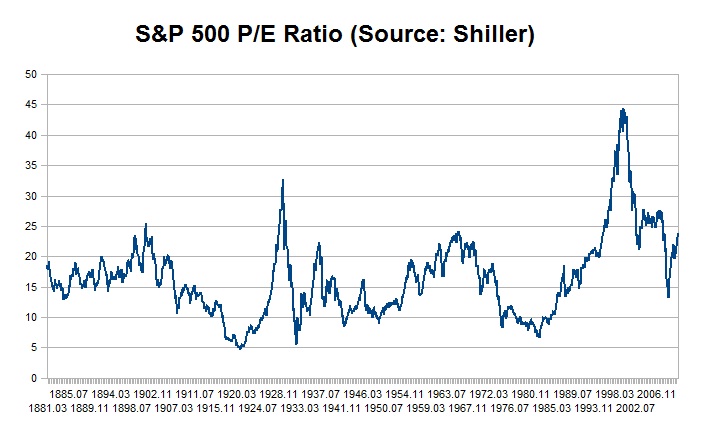
To measure this ratio of the price you pay to the profits you'll make, there is a thing called the P/E ratio. It takes the price of a stock and divides it by the earnings per share, showing you essentially how much you are paying in stock price for $1 in earnings. The higher, the worst the deal, the lower, the better.

Now the average has been since 1880 a ratio of roughly 15. Meaning you paid $15 in stock price for $1 in earnings. However during the peak of the Dotcom Bubble the P/E peaked at 45. That bubble burst, bringing the ratio down to 22, STILL NOT A GOOD DEAL.

But, ANOTHER SWPL fad came in - home ownership and condos and mcmansions!

THis drove the P/E ratio up again to 28, only until we found out the SWPL fad of buying a house you can't afford was not a sustainable economic behavior.

The Dow Jones dropped to 7,000 and with it the P/E ratio reached 14!

HURRAY!!!! LOOK AT THAT!!! THE STOCK MARKET IS ACCURATELY VALUED!!!!

NOT UNDERVALUED

ACCURATELY VALUED.

And so what do people do with stocks that are neither a steal nor overpriced, but just sanely valued?

A buying frenzy.

They drive the Dow Jones back up to 12,000 because SWPL's like to pay high stock prices for low earnings resulting in a P/E that is now around 24, implying a 30-40% overvaluation (denoted by the latest quick jump at the end of the chart).

Now Professor Robert Shiller, who is a real intellectual, not only provided this information, but logically concluded stocks are now overvalued again.

But ohhhhhh, my goodness! The SWPL's don't like that! They want stock bubbles! They want happy fuzzies for everyone! They want unicorn 401k's where you never have to work and solely rely on forever increasing asset prices to pay for your retirement. And they go out of their way to find a rationale or reason to continue living in SWPL Land.

Well, there's just one more problem with that guys.


See, while arguments can be made about whether you use earnings, EBIT, EBITDA and other things that aren't the bottom line, ultimate what drives stock prices are DIVIDENDS.

Because (and here's the economic lesson of the day), it is the only real cash flow a stock generates.

Oh, sure, you may sell the stock to another person generating a capital gain. But that didn't come from the stock. It came from another person. And the only reason that person paid you money for that stock is why?

Because the only thing a stock really generates is dividends.

And it is here, the only one TRUE cash flow that makes it to the stock holder and the only one TRUE cash flow that provides a stock with value that the situation is dire.

Below is the "dividend yield" for the S&P 500. This mathematically is the dividend per share divided by the price per share. In other words the rate of return you can expect from dividends.

And while the history of the dividend yield shows a rough average of about 5%, notice the general trend downward?

It reached a low back in the Dotcom bubble of 1.8%. Wow, that's a GREAT return! Let me get my checkbook out!

Of course there was a dose of sanity when the stock market collapsed this last time around, driving the dividend yield up to a whopping 3%.

But oh no. We can't have that! That's not SWPL! SWPL's like over valued stocks! We don't want any of those icky yuck gross dividends! And so with the reinflation of the stock market bubble the Dow Jones magically doubled in 2 1/2 years with no real economic growth, no real improvement in our economic future, sending the dividend yield back to 2%.

Now economists can go ahead and pull out their hair (like I did) about why the American public just plain doesn't get it and keeps on investing in overvalued markets. They can rack their brains asking, "did these people NOT just go through two massive bubbles??? Did they not learn their lesson? How did they DOUBLE the value of the stock market when the economy is in such dire shape and there's really no economic hope for the future?" But they will simply increase their blood pressure.

For there is no "logical" or "sane" reason these bubbles persistently and constantly form. It's much simpler. It's the same thing that causes people to make "going green" a hobby. It's the same thing that sends millions of people to fork over $10 a ticket to see mediocre movies. It's the same thing that makes people listen to something as boring as public radio.

It's SWPL!

Enjoy the decline!

Monday, October 13, 2008

S&P 500 Dividend Yield

I wrote a post showing the S&P 500 P/E ratio going back to 1871. I then said that if you looked at history, a DJIA of about 9,000 or so was "about right." However, there was criticism in that it is not earnings, but dividends that ultimately give a stock value and therefore should be the base by which to determine if prices were overvalued or not. This is most certainly correct as the only form of cash you will ever receive from a stock is dividends (and then when you sell the stock or the company is bought out, a capital gains).

Regardless, it is the abandonment of dividends for capital gains to finance our retirements that has resulted in a bubble. And even in using the dividend yield (dividends divided by price), the picture painted is much worse. Stocks, even with the crash in the past two weeks are still overvalued based on the only thing that matters; dividends. We're still not even close to the historical average dividend yield of 5%. Ergo, why buy stocks now?


Of course in light of today's 600+ point rally, people are suggesting I have egg on my face and that the bottom has indeed been reached (no doubt from hence forth stocks will perpetually go onward and upward as Obama will be elected and we'll all have warm financial fuzzies). But allow me to point out two minor things;

1. What if all the increase in stock prices for the past 30 years was due to cash flowing into the stock market from retirement plans, not necessarily because those stocks were good investments making them fundamentally overvalued.

and

2. What do you suppose will happen to stock prices if not only Obama is elected, but the democrats get a veto proof majority?

Enjoy your cute little rally.

Saturday, August 28, 2010

Dividends

As some of you know, I teach a BRILLIANT online course on stock valuation and analysis. I say it's brilliant not to brag, but because it really is brilliant, there's nothing like it in college. It covers not just how to read financial statements and how to calculate ratios, but picks up where colleges fail and TEACHES YOU VALUATION TECHNIQUES. YOU SHOULD TAKE IT.

In any case, I had a student ask a question about dividends, the answer to which I realized would be of benefit to all the Cappy Capites out there, not to mention the everyday Joe's who are having a hard time understanding why their 401k isn't skyrocketing through the roof during these glory days of hope and change.

So I submit to you more of my economic genius;

Yes, everything you stated is correct. To clarify though what drives the value of a stock or what it is you are precisely selling to another buyer on the second market, let me further explain.

What you own when you own a share of stock is the right to the proportional earnings of that corporation. Now, of course not all companies pay out their earnings in the form of a dividend. They will retain ALL of the earnings and reinvest them back into the company.

Now you would say, "well then why should I own the stock if they NEVER pay a dividend."

And you would be correct. If a company NEVER pays a dividend, then that stock has no value. You just gave the company (or secondary market seller) money for a piece of paper that will never give you money in return.

However, companies inevitably DO pay dividends. The reason they retain earnings and not pay dividends is to grow the company so they can earn even MORE money in the future.

Now this is where investing philosophy gets cute. Companies are typically very arrogant about paying dividends. They ALL think they're going to grow into huge multi-billion dollar behemoths and then, MAYBE THEN they'll pay you serfs some pittance of a dividend. Of course what is more likely to happen is they inevitably go belly up. What they SHOULD do is when times are good is pay out some of their earnings as a dividend otherwise the stock IS worthless.

Now what's interesting (and scary) about this, is it shows you a MAJOR flaw in today's conventional retirement system - everybody buys stocks because they "might go up in the future," not because they pay dividends. Well the question is "what drives stock prices up?" And the answer is scary;

Only dividends can drive stock prices up.

The reason why is when you sell a share of stock, yes you may have made a gain, but why did that buyer buy it from you? Well, because today or in the future that stock will pay dividends.

No matter how many times a stock is bought or sold, it only has value because either today or sometime in the future it's going to pay a dividend. So you are essenitally selling the right to future dividends when you sell a stock. Ergo, dividends (or the likelyhood dividends will be paid) is what drives stock prices.

So what this means is you currently have 100 million Americans all throwing their money into 401k's and IRA's and 403b's NOT because all these companies are paying great dividends, but because they magically think "stock prices just go up" for random magical reasons.

This is why you will want to DEFINITELY look at the "dividend yield" of a mutual fund or a stock before you buy it to make sure there is real cash flow associated with the stock and giving that stock something of value.

Friday, October 21, 2016

The Clarey National Debt Plan

In part because the economy was collapsing, in part because I found it easier to analyze economies instead of companies, I made a foray into currency trading about 10 years ago.  Analyzing companies was becoming boring, not to mention more of a game predicting which government policy would affect which industry as opposed to looking at fundamentals like earnings, debt, and cash flow.  And so, using techniques nearly identical to those I used in commercial lending, I bought some Swiss Francs, Australian Dollars, and Singaporean Dollars.

I did well.

Very well.

And because of the leveraged nature of currency trading was starting to wonder if this wasn't a quick way toward riches and my true calling.  That was until....

the Swiss central bank decided it's currency was too strong and purposely started to pummel it's own currency.  Once again, I would have to predict government policy and not economics or fundamentals as the currency market was no longer efficient, but merely a reflection of government and bureaucrats.

But then it got me thinking.

"Wait, if countries purposely weaken their currencies because there's a benefit (in this case, their export industry doesn't lose business or jobs because their goods are in higher demand overseas), then there must also be SOME kind of benefit to having a strong currency as well.  In other words, in a "equal but opposite force"-type-law of economics (that I truly believe exists) what would be the benefit of a country with a strong currency?"

And then I made the connection.

Purchasing power.

I witnessed this the more I traveled overseas and realized in Mexico, Jamaica, the Bahamas, even Canada, countries would gladly accept greenbacks, saving me and other American visitors the pain of converting currencies.  I also remember a John Stossel episode where he could more quickly hail a cab in Russia flashing US dollars (and cigarettes) than the local Rubles.

But then it really dawned on me.

If a country were to have a very strong currency, if it were to adhere to free market economics, then it wouldn't weaken its currency to protect it's export base.  It would let its citizens buy world goods AND INVESTIBLE ASSETS on the cheap.

This made me wonder "couldn't the US immediately after WWII just printed off a couple billion dollars and buy all the world's productive assets in 1945?"

Which makes me wonder, "Couldn't we do the same today?"

And this is the underpinning epiphany of The Clarey National Debt Plan.

While other people's national debt reduction plans are based on some combination of cuts, fiscal discipline, frugality, and taxation, my idea is much more international and opportunistic.  For while the US may not be in its supreme position it once was back in (the evil, racist, oppressive) 40's and 50's, the truth is neither is the rest of the world.  And poor as our finances are, the world's is even worse.  Alas, we still have the world's reserve currency and we can (and do) abuse the hell out of it.

For example the money supply (using the monetary base as the measure) has increased 350% under Obama.  That should result in inflation of 350%, but it hasn't.  The money has been sopped up in recapitalizing banks, bailing out bad mortgages, and bailing out other bad investments, wherein the money sits on a balance sheet or in a vault, never allowed to circulate (and thus cause inflation) in the economy.  The money has also been used to finance bubbles such as new mortgages, student loans, and corporate buy backs of their own stock where inflation has occurred, but we don't care about it because we like it when "stocks go up," "housing prices go up," and millennials believe "you can't put a price on education."  The third area this money has gone is overseas where countries such as China, Russia, Brazil, and all of Europe are in such WORSE financial shape, our dollar and it's horrible fundamentals are still relatively attractive and act as a "safe haven" investment.

In other words we're like the only girl in Casper, Wyoming with all of her teeth.  Hideous, disease infected, and the mother of 4 from 3 different baby daddies, but we're still the best looking horse in the barn.

I say "why not capitalize on this?"

Since printing money does not (directly or immediately anyway) result in inflation, why don't we avail ourselves of this undeserved purchasing power, print off $22 trillion, and go on an acquisitions binge across the globe?  I say "acquisitions binge" and not "pay off the national debt" because, while printing off $22 trillion to merely pay off our debt is possible, I do believe the global markets and rest of the world aren't THAT dense and they would immediately dump the dollar immediately causing real inflation at home.  But if we instead INVEST that $22 trillion in assets that generate an annual profit not only does that give those $22 trillion in US dollars intrinsic value (and thus hopefully stave off inflation), but the annual profits from these investments could be used to pay down the debt.  And that's the twist to the "Clarey National Debt Plan."

I've ran some figures.

There's $44 trillion in publicly traded global equities of the G20 nations.  These securities on average pay a dividend yield of 3.156%.  You may ask "why would you only print off $22 trillion, why not a full $44 trillion and buy these global equities outright" and the reason why is you don't want the US government becoming majority shareholder of anything.  They'd ruin the underlying investment forcing unnecessary corporate social responsibility initiatives, under-performing minorities in positions of power, mandating carbon footprint quotas, and a whole slew of politically motivated leftist slop that would destroy the profit potential of these firms.  You want the US government to be a silent, non-participatory, non-intervening partner, and ensuring they only own 49.9% (thus the $22 trillion) of these firms is a way to do that.

A 3.156% annual dividend yield on $22 trillion generates $694 billion in proceeds each year.

Assume there's a balanced budget (which is the LEAST likely assumption in all of this theoretical plan, and sadly, I'm not joking), and the national debt is paid off in a maximum of 28 years, probably less assuming growth in earnings (there's technically a way we could eliminate the national debt in a year or two, but I'm not paid enough to consult on these matters).

Now admittedly there's plenty wrong with this idea.

One, printing off $22 trillion (I would hope) would cause the currency markets to crash (indicating there's at least some sanity left in this world).  But here's where the juicy irony lies.  We just almost quadrupled the money supply under Obama/Yellen/Bernanke.

I ask you one simple question:

Where did all that money go?

If you look at the federal reserve balance sheet and the federal budget this newly minted money went to the following places:

1.  Bailing out unprofitable banks
2.  Bailing out other unprofitable financial firms
3.  Bailing out unprofitable people who borrowed more than they could afford
4.  Bailing out people either via welfare, EBT, social security, etc., ie - parasitic people who do NOT produce a net positive economic production
5.  Wars/military (where in once again, the purpose of the military is to destroy things, not make a profit)
6.  Forcing the tax payer to bail out millennials from their worthless, idiotic degrees (oops, wait, that hasn't happened...yet)

In other words, NOT ONE PENNY was an actual investment as you expect to get a positive return on investments.  These were expenditures on money losing operations, money losing people, money losing wars, and the just plain losers, degenerates, and scum of our society.  There was no hope of profits, earnings, dividends, cash flow, or capital gains.  It was simply a pissing away of money.

When you realize this you'll see my plan is INFINITELY more sound, logical, and sane because there's an actual profit at the end of this $22 trillion investment.  And that's the key word - it's an investment.  If markets are as sane as they are now, and consistent, the dollar should (ironically) SURGE compared to other country's currencies because unlike Greece, Japan, Europe, Brazil, and nearly every other country we wouldn't be bailing out our country's losers, but investing in global winners.

This then leads to the second problem - inflated stock prices.

If it were to get out the US government was on a $22 trillion global spending spree stock prices would jump to the point the purchasing price would no longer make this plan viable.  Additionally, as it just so happens, central banks are already doing this just the same.  But while smaller central banks such as the Swiss, Singaporean, etc., might go and take such actions, they're too small to drive prices up significantly on the global markets.  The US is too big.  Ergo, kind of like China, they'd have to do it clandestinely and secretly through unremarkably named subsidiaries and shell companies.  This would take some time to slowly, indirectly, and discreetly amass a $22 trillion global equity portfolio, but in time it could be done, especially if there are dips or crashes in the market.

There are other problems with "The Clarey National Debt Plan," but truthfully it would be a waste of time further exploring what is already an academic, theoretical exercise.  The balls that would be required to execute this plan just do not exist in the US.  While Japan and Australia have the spine to end their worthless degree bubbles, our president apologizes when he states the truth about art history degrees.  And the student loan bubble is merely 1/20th the size of our national debt problems.  However, we can learn something from this intellectual exercise aside from just what a bunch of self-deluding clowns and asshats the central banking/governmental/international finance "authorities" are.  And that lesson is the only source by which national debts can be paid off if through the economic production of the people.

In other words, government is not a solution to anything as it is the underlying people who are the ones with not only the power, but the economic production potential necessary to make good on whatever promises their governments made.  It is cute that today's international economy is so screwed up that the US could just waltz in, print off $22 trillion, and purchase the productivity of the world's productive classes, which would bail out our parasitic and lazy classes, but it doesn't change the fact that when it all boils down to fundamentals, economic production of the private sector is where ALL economic worth, value, and wealth comes from.  And if you really want to build a successful society, civilization, or country, I suggest you found it around this key and vital principle.

In the meantime you central bankers, government bureaucrats, and international bond traders enjoy the decline!
______________________________________
Visit Aaron at his other sites or consider purchasing some of his awesome books!
Podcast
Asshole Consulting
YouTube Channel
Twitter
Books by Aaron
Amazon Affiliate

Thursday, June 26, 2014

The Real Rate of Return of Stocks

Follow young Cappy on this financial and intellectual endeavor and learn something you just aren't going to find in the MSM.

Understand that there is no such thing as capital gains when it comes to stocks.

Yes, I know there IS such a thing and that it is proven everyday day, but theoretically there shouldn't be any capital gains, let alone an entire retirement industry based on capital gains because, in theory, a market would be efficient enough to price all future profits into the current day price of a stock leaving no room for capital gains.

So why would you own a stock?

Dividends, my good boy.  Dividends.

The reason why is that dividends are THE ONLY THING THAT IS PRODUCED BY A CORPORATION THAT IS ACTUALLY PAID OUT TO ITS SHAREHOLDERS.  And this is a very important reality to understand if you wish to understand the value of stocks, because when you buy a stock you aren't

"buying the right to vote"

or

"purchasing a percentage of the firm's assets"

you're not even getting

"a percentage of the firm's profits."

No, you get a proportional percentage of the dividends that are paid out, if any.

That's it.  That's all a stock is.  A right to a proportional percentage of future dividends the company may pay out.

Ergo, it is ONLY dividends that matter and drive the value of a stock.

So how do stock prices stack up against the dividends they pay?  What kind of percent rate of return can you expect from dividends?  Well historically you could expect a rate of return around 5%.  But with retirement dollars and QE money flooding the market, stocks have been driven so high without a commensurate increase in dividends that you get

are you ready for it?

a WHOPPING 2% rate of return!

But are you really even getting that?

I was listening to the Kerry Lutz show and he had Danielle Park on who made the very astute point of "what about inflation?"

Indeed what about inflation and so with my SAEG I went and calculated the dividend yield going back to 1914 and adjusted it for inflation.  And shucks howdy, look at that!


Stocks really haven't been providing a positive rate of return since about the mid 70's.

A couple points, however.

One, the negative rates of return from 1974 on are obviously caused by the oil embargoes and inflationary days of the late 70's.  However, ever since then, rates have more or less remained marginally negative, stocks never really beating out inflation.  It behooves the question why are stocks going up at in real terms since their ONLY driver of value (dividends) is effectively providing negative rates of return?

Two, the retirement bubble got it's official kick off in 1978 when we had our first ordained retirement plan (the 401k).  Since then the stock market has been flooded with dollars which may have driven up capital gains (and made everybody happy on paper), but driven the real rate of return on dividends below zero.

Three, despite the dramatic increase in the stock market since 2008, you'd think inflation-adjusted dividend yields would be driven into negative territory.  However, oddly enough, they're positive in the fraction of a percentage point range.

Why?

Inflation is very low...or so we're told.

The question is if you believe the official CPI numbers being churned out.

The larger point is not one of whether inflation is being manipulated or retirement dollars are flooding the market or QE-X is driving prices higher, but yields lower.  It's just what a lousy investment stocks have been post - WWII when you look at the only thing they produce - dividends.

We don't get excited about bonds that only pay 3%
We whine about our savings accounts and CD's only paying 1%

But by god and shucks howdy, we'll plow trillions into a stock market that pays -.5% because...capital gains.

I just hope when Economics 101 classes are taught in the future, right along side the "Holland Tulip Bubble" some kind econ prof will cite this post.

Enjoy the decline.

Wednesday, May 13, 2015

Why Entrepreneurship May Be the Only Feasible Retirement Plan

I had faced a problem.
For the first time in a while, the ole Captain had enough money saved up that he could start thinking about throwing some money in the ole IRA.

You might at first think this is not a problem.  But it is, young aspiring economist.  It is.  For the problem facing anybody under 65 who still has a bit of life expectancy left is:

Precisely what do you invest your money in?

All of you know my general concern that money coming from:

1.  Retirement dollars of baby boomers and Gen X
2.  Quantitative easing money being injected into the financial markets and
3.  Low interest rates prompting a trillion dollars worth of buy backs

is jacking up stock and other asset prices that there's effectively no good deals out there.

The PE ratio shows the stock market overvalued by almost half:


This results in a dividend yield of LESS THAN 2%


Housing only pays a whopping 4% today (and that's if you don't consider repairs and expenses)


And even an investment like education increasingly fails to generate the returns necessary to validate it.


Alas, today's investor is faced with the following effective REAL rates of return:

Stocks 0%
Savings -1%
Real Estate 2-3%
Education - HA HA HA HA HA!!!!!

Now naturally, many of you are saying,

"Wait!  0%???  The stock market has been booming!!!  How do you get 0%?"

Well, inquiring young mind, I'll tell you.

You see, there is no such thing as capital gains.  The real rate of return stocks (or any other investment for that matter) provides is the income or profit is generates.

Housing generates rents
Bond generate interest
And stocks generate dividends

However, ever since we thought it'd be a grand idea to designate stocks, bonds and other marketable securities as the default investments for our IRA's and 401k's back in 1978, stocks have gone up NOT based on their profitability, but by simply how many trillions of dollars-worth of mindless sheeple's money they throw into their 401k's accounts every paycheck.

Microsoft hasn't paid a dividend since it's existence?
Screw it, buy more.  The price might go up!

The S&P pays less than a Kaazaa account?
Screw it, buy more!  The price might go up!

Tinder or Twitter don't generate income at all!!!???
Screw it, buy more!  The price might go up!  IT'S AN IPO!!!

And so why we see the above ABYSMAL and PETTY REAL rates of return for the various asset classes.

So where precisely is somebody who demands an adequate rate of return to invest their money?

Sadly, it looks like entrepreneurship may be the only place to go.

It wasn't until I was having a conversation with my dad while running did I notice that even with all the tax benefits and government incentives to invest in IRA's and 401k's, the best use of my money is sadly to reinvest it in my various ventures.

If I drop $500 advertising my books on the Tom Leykis Show, I on average double my money. 
If I drop $100 advertising Asshole Consulting on Viva la Manosphere, I get about a 60% rate of return.
And if I drop $200 running ads on Marginal Revolution for my books, I get about a 70% rate of return.

Naturally of course, I don't enjoy any of the tax benefits on these investments that come with the government ordained IRA's and 401k's.

But so what?  Even adjusting for taxes, investing in your own private ventures generates MUCH higher rates of return than the government approved investments for your retirement account.

Tom Leykis post tax rate of return = 75%
Stocks (still) = 0%

Viva La Manosphere post tax rate of return = 45%
Bonds = 1.2%

Marginal Revolution post tax rate of return = 50%
Real estate = (post property taxes, repairs, insurance, etc.) -5%

Now naturally key to all of this is to get a product or a business in place where expending such money on advertising, equipment, etc., would generate such returns.  And I will be the first to admit that that is not easy.  For every successful business I have, I have at least 2-3 that have failed, and that says nothing of the labor put into researching, trying and deploying these ideas.  But all those drawbacks aside, returns are so non-existent in today's financial markets, you may not have a choice.  It is a mathematical impossibility to rely on today's conventional retirement planning tenet of "compounding rates of return" when those rates are effectively at or near 0%.  Ergo, it practically behooves you to have your hand at entrepreneurship and see if you can't make up your retirement from scratch.

Of course, most people will point out and say, "Not everybody can be entrepreneurs!  If we all became entrepreneurs there'd be no workers or economy!"

Thankfully, nowhere near "everybody" reads Captain Capitalism.

Now if you'll excuse me, I'm going to go and work on my next business idea.

Thursday, September 11, 2014

Asset Prices Outstripping Economic Growth

Two of my favorite charts (and I'm sure they're yours) is the S&P 500 PE ratio and dividend yield.  It is the basic comparison of what you're paying for a stock relative to what it pays you.

But every once in a while I like to go really macro and compare the country's economic growth to its asset prices.  In theory (bar international investments and trade) asset prices should not be increasing faster than economic growth in that all profits must come from economic growth.  Therefore, both asset prices and economic growth should grow at the same rate, otherwise we know there's either a bubble or a (well...it's been so long...what was it again we call stock markets that are cheap....um....oh!  That's right!) steal. 

So I took it upon my beleaguered economist ass to go and pull the data comparing the annual returns of the S&P 500 and subtracting out from it nominal economic growth which should in theory always be 0.

Heh, yeah right.


Naturally there's going to be oscillations and bubbles and troughs in any economy.  But given what we know about the PE ratio now being 70% higher than it should be, I just wanted another data set to view this from a different angle.  And this one didn't disappoint.

We see, during the economic crash, stock prices crashing even more sending the net difference between asset prices and economic growth into negative territory.  This meant asset prices were growing slower (crashing faster, actually) than economic growth was.  However, this only lasted one year (2008) and in 2009 where the economy contracted on a yearly basis by 2.9% the stock market punished this performance by awarding this slowing economy with a 25% increase in valuation.

This is like your kid coming home with straight F's and you increase their allowance by a a full fourth.

Since then the disconnect between economic growth and asset prices has continued as asset prices have averaged annual gains of 15% while the economy has managed just under 3%.

I'm going to say it again for the cheap seats and hope to god some future historian looks this up and sees it, but this is just another bit of proof that Americans are more interested in baloney asset bubbles than they are actual economic growth.  It is the modern day epitome of American psychology where we want all of the rewards, but without having to expend any of the work.

Does it matter that stock prices are being driven by retirement dollars and not profits?
Does it matter that equities are being driven by QE and low interest rate monetary policies which prompt corporate buy backs?
Does it matter economic potential in this country is so low corporations would rather buy back shares than invest and create jobs?

No, because prices are up and that's our super happy fun juice!

I know the federal reserve is powerful and that the world economy is already structured around a US dollar reserve currency.  But neither are more powerful than the forces of math and reality.  I just hope to see that reality manifested before I die.  In the meantime, Enjoy that Decline!

Wednesday, February 29, 2012

The Curious Case of the Disappearing NYSE

In what I would consider one of my top 5 economic pieces of this blog I tie the majority of the stock market's movement NOT to profits, earnings or dividends (as it should be) but rather to the volume of retirement dollars flooding the stock market. The ramifications, of course, is "what will happen to stock prices when the baby boomers retire and withdraw their trillions of dollars?"

Economics would tell us "go down" but what's funny is markets are not rational all the time. Matter of fact they can remain quit bubbly for extended periods of time. ESPECIALLY when the market participants (AHEM AHEM, COUGH COUGH - AMERICANS) are addicted to "high asset prices" because it fools them into thinking they don't have to work for a living. Asset prices just magically go up without the necessary production and profits to rationalize the price increases. And this can go on "forever" or at least until the delusional (and lazy, I might add) Americans retire.

We see this today where the dividend yield is still at a historic low going back to 1890 and the PE ratio is still above it's historic average of 15x's. The profits are simply not there to rationalize the lofty prices. However, there is something more amiss going on beyond the simple "retirement dollars flooding market" and it may not be obvious to the naked eye.

Volume.

With the DJIA breaking 13,000 and the economy showing signs of a tepid recovery, you would think the market would be doubly flooded with money. The monies flowing in from automotonic 401k retirement drones AND the new monies flowing in from people with new-found hope that the economy is indeed turning around and America has a future once again.

There's just one problem - the volume isn't there to support it.

If you look at the volume of the NYSE, it's cratering. It's lower than it has been in over a decade


This doesn't jive with the prices we see in the market. In basic economic theory, the more trading volume there is in a market, the higher prices should be in that is shows a demand for those stocks. Additionally, with increased volume comes increased "liquidity" which in itself provides a premium that should translate into higher prices. We are now getting the opposite.

So what is happening?

Well, your humble Captain has a theory.

The reason volume is tanking is because, despite what heavily-spun news you might hear about GDP, consumer confidence, the reality is that the economy still sucks. Unemployment, though down, is still 2 full percentage points above the WORST it ever was under George Bush. If you want to consider the "underemployment" argument, that many people have left the labor force, you could argue unemployment is closer to 11%. Additionally, even with today's revision of 3% RGDP growth, it's nothing compared to the booming quarters we had after most recessions (even the hated, incompetent,evil puppy-kicker GW managed a quarter above 6%). Also delivering a dose of realistic doom to the economy is the massive amounts of debt we have. And finally, unemployment is particularly high amongst the youth, who are not only necessary to bail out older generations via their public pensions, but whose retirement dollars are also necessary to keep the 401k Bubble/Ponzi scheme going as well. But just like the housing market, you need jobs in order to afford a house. And so, I'm sure if you looked at it, a huge reason for the lower volume is the lack of "new blood" entering the retirement/401k market, plus the fact people just don't plain have the disposable income to afford IRA contributions.

While this explains the collapse in volume, it doesn't explain why prices are still so high. And here is the nefarious side of the theory:

Something nefarious is going on.

When you see Apple with a market cap of 1/2 trillion dollars, you start to wonder why Apple is so valuable. And as it turns out it's because hedge funds and mutual funds all want to own Apple. No real financial reason for it, hedge fund managers, mutual fund managers and other incompetent perma-bubble Wall Street dolts like shinny new electrical doo-dads just like their spoiled brat, humanities-majoring children at home in Connecticut do. But what this shows you (or at least alludes to) is that it is institutions, not individuals, that are accounting for the majority of the buying and selling of the stocks. You also throw in electronic trading programs or "computerized trading" and it's no longer real investors with real money, as much as it is a potentially rigged beast of its own trading on itself.

It reminds me of a now-deceased publication called "Lake Minnetonka Magazine." This magazine was basically the socialite magazine for Minneapolis' uber-rich western suburb. Here is where Cargill, Carlson Companies and many more firms are based, as well as the hundreds of trust-fund babies these empires spawned. The magazine itself though was a self-absorbed love fest within itself. Written by the trustfunders about the trustfunders and all the parties they went to and who bought what Italian car or what worthless trophy wife opened up what worthless trinket shop with her hubby's money. Essentially it was a club or an entity that didn't produce anything and when its founder (ahem ahem-Tom Petters) was arrested for what was then the largest fraud in the history of the US (soon to be outdone by Bernie Madoff), the magazine went bye bye (ironically, shortly after, there were a LOT of for sale signs on the prestigious Lake Minnetonka, what handsome, dashing, chiseled motorcycle riding, fossil-hunting, bad-boy economist would have predicted that!).

In short, the stock market is being artificially inflated, if not, limped along, by the sanctimonious (or perhaps, oblivious) yutzes trapped in their own nepotistic, inbred echo chamber called "The East Coast." They trade amongst themselves, they believe that the stock market is a finite, mathematical beast that can be predicted. They have NEVER seen a real stock market crash, as they're perpetually bailed out by Dotcom Bubble after Housing Bubble after QE-LXI Bubble. They are truly oblivious to all the work, toil, labor and entrepreneurialism that gives those worthless pieces of paper (they so love to trade and sell and take commission on) value.

The question is if you wish to join this little clique or social party. Do you want to "hang" with all the fake and plastic of the paper-rich, asset-poor, and soon to be bankrupt class? Then by all means, throw that $16,500 max of your money into an inflated stock market every year. You'll be one of the cool people. But if you're more like me and want to hang out with your non-stab-you-in-the-back buddies at a reasonably priced bar, entertained with good intelligent conversation, and darn fine food, you may want to look elsewhere and hang out where there is real value.

In the meantime, enjoy the decline!

Wednesday, January 29, 2014

Wednesday Night Linkage

How sad is it we're happy with a 3% dividend yield?  Nope, no bubble here!

My hatred of teachers is justified.

Your career, your education, and you are more important than your child.  Your child is there to serve you and satiate your biological clock.  It is to be spat out and then jettisoned to the local state financed child care facilities immediately where it will be programmed to vote for glorious socialism and the destruction of the family.  You will obey.  You will conform.  You will "go girl."

It's not easy being a manly Christian.

A legitimate criticism against keyboard-jockeying.  Again, The Manosphere is not an academic department at a university where you theorize.  It is meant to be a tradeschool where you get in, get your education, and get out and apply it to the real world.  Pontificating and theorizing 100% of the time behind a computer screen is not helpful.

Good thing you weren't college material!

And the "Bad Dad Award" goes to Joe Wethington for blaming his mistakes on companies!

You bleeping idiots can't even predict weather 3 months into the future.  The only people dumber than you are the fucking idiots who actually believe you know what you're talking about with this global warming scam.

The importance of "unlearning."

Thursday, March 14, 2013

Charty Goodness

I have a confession to make.  I am lazy with my charts.  I normally will make a chart and its shelf life can last several years, if not, a full decade as long as the economy doesn't change too much.  For example the stock market has remained bubbly over these past few years rarely requiring I update the S&P 500 PE ratio or dividend yield.  But the same cannot be said for Obama's deficit spending and accrual of debt.  Each year I have to update any debt related charts because the SOB adds another trillion+ to the deficit every year.

Poker Joker - Obama Playing Down 
Debt
Original Source: Poker Listings

So here are the two main charts (updated) attesting to debt - deficit and debt to GDP.


For S's and G's I decided to also check to see how much the federal budget was as a percent of GDP:


I love the jump in spending not just under Obama, but how the American public keeps voting in to have government play more and more of a role in our lives.  And that chart above is JUST FEDERAL.  Tack on another 10% to account for state and local, 20% if you're a sucker and live in California.

Wednesday, November 09, 2011

Hot Diggity Dividends!

In addition to mortgaging the past, present and future, bringing us scourges such as "sexual harassment," the EPA, "going green," "feminism," "global warming," the "ozone layer," the "housing bubble," the "dotcom bubble," the 'education bubble," "progressive certification," accounting scandals and an infinite amount of other socio-economic-political crap that has essentially destroyed the country, you can thank the Boomers for one additional thing and that is flooding the stock market with so much retirement dollars it makes it impossibly unaffordable for anybody else to be buying into stocks right now.

Regular Cappy Cap readers will already be familiar with the chart below, but as a refresher, the chart below shows you what's called the "dividend yield." This is the rate of return you can expect from dividends as a percent of the stock price. The reason this is important is because the ONLY real return you get from a stock is dividends. The ONLY thing a stock pays a shareholder is dividends. The ONLY reason you should invest in a stock (long term) is dividends.


And thanks to trillions of dollars flooding the market, you now get a WHOPPING 2% rate of return through dividends!


Bullets and Rumpleminze would make for a better (and more fun) investment.

Tuesday, March 06, 2012

Doug Short Is the Captain's Long Lost Brother!

Mr. Short, I believe must be my long lost twin brother.

Older.

More gray haired.

Probably not a salsa dancer.

But my long lost twin brother none the less.

He focuses on Tobin's "Q quotient" whereas I am lazy and just look up a mathematically similar measure over at Dr. Robert Shiller's office, the S&P 500 P/E ratio.

The moral of the stories are the same.

The stock market is overvalued. It always has been since idiotic politicians decided us people were too stupid to know what to do and engaged in the largest and (soon to be) most damaging social engineering project ever - the 401k/IRA/government ordained retirement program.

Let's essentially ordain the stock market as the ONLY means by which you can save for retirement. AND HEY, GUESS WHAT, let's give 300 million Americans a TAX INCENTIVE to throw their money into the stock market regardless of whether or not its a good buy. No, that won't cause a bubble now, will it?

I'm not a conspiracy theorist, but something tells me Wall Street might have had a role in getting this legislation through.

Regardless, it's nice to see somebody older than me (and therefore wiser, because I know how you baby boomers like to dismiss any human without gray hair as a "moron") point out what I've been pointing out since (cripes???) 2006???

But, no, no. You kids go ahead. I'm just an evil, party pooping republican trying to bring everybody's good time down. You throw your money into the S&P 500 when it only has a dividend yield of 1.8% (Herb, point of tax preference duly noted). I'm sure some spectabulous Obama Unicorn will fly over and fart economic fairy dust to overcome all of our economic problems and all of you baby boomers will retire in comfort, as will, of course, all of you Gen X'ers and Gen Y's who believe in social security, medicare and unicorns that fart economic fairy dust.

I shall part, with something that will probably be lost on most of you pinning your hopes on the woefully underfunded 401k plan:

Enjoy the decline!

Tuesday, February 13, 2018

The Best Investment in 2018? Paying Off Your Debts

I'm not going to beat the dead horse of comparing the S&P 500's pathetic dividend yield of 1.7% or the below-inflation rates of interest you can get in savings accounts to the 4-25% rate of return you can get by paying off your debts.

I'm simply going to point out the bullshittery that happens in America's blessed "stock market" that you sheep all invest in because you're stupid and never question why you save for retirement.

Friday, January 03, 2014

Yes, Bill, the Market is Still Overvalued

One of the most irrelevant and insipid arguments liberals love to tender when you critique a democrat president is,

"OH YEAH!!!  WELL THE STOCK MARKET IS DOING WELL!!!"

Forget that unemployment is still recession territory
Forget that underemployment is at an all time high
And forget that economic growth is stagnant

No, find that one statistic that has NOTHING to do with presidential or economic performance.  AND cite something you normally hate and loathe - Wall Street - as a metric.

Regardless, I didn't follow the market for jack during 2013.  This is in part because I have no money to invest and also in part because it is overvalued due to all the retirement dollars that have been flooding it since the advent of the 401k.  But while sitting at my favorite bar, I caught a glimpse of a chart of the DJIA on the TV.  And it looked like it was almost at 17,000.

"This couldn't be.  What has happened in the economy that would warrant that?!"

So I admitted I was ignorant about the stock market for the past year and decided to go right to the source and ask the horse, for Dr. Robert Shiller will give you the answer you'll endorse - the S&P 500 P/E ratio.


In other words, "nothing to see here people."  It's the same damn thing that it's always been.  Earnings haven't been going up, but prices have, resulting in an even more-inflated bubble.  Historically, the S&P has traded at a PE of 15, and now, WITH NO LEGITIMATE ECONOMIC REASON OR RATIONALE the market is trading at a 67% premium over its historical average.

Again, for the cheap seats, this means if you buy stocks today it is like paying:

$5.44 for a gallon of gas
$680 for an XBox One, or
$12 for a Chipolte burrito

And don't even get me started on the dividend yield.

In short, nothing has changed, except for the severity of the bubble.  Bar the Great Recession, the Dotcom Bubble and the Housing Bubble, the stock market has never been so overvalued.

Tuesday, March 10, 2020

Why the Coronavirus is Better for Millennials Than College

This post does not endorse any financial advice and all advice herein is horrible and will likely cause you to lose all your money, your house, and your wife.   Talk to a financial advisor about investing, not this horrifically-bad-at-economics blog.


Well, let's be honest first.

College was in reality about the worst thing to happen to the Millennials.  A swift kick in the nuts would have served the Millennials better than college, so it isn't that hard of a "gift" to beat. 

But I am being deadly serious when I say that Coronavirus is better for the Millennials than college, and I will go further to say it's the best thing to happen to them in their lives.  Because while the world frets that it's about to come to an end, countries issue travel bans, countries go under lock down, and corporations allow you to work from home (which now you KNOW it's bad) there is something else happening to the Millennials' great great favor.

Prices are going down.

Though related to a separate incident, I noticed the price of gas dropped to $1.92 in my area.  I already knew stock prices had been dropping due to Coronachan, but it was that harsh drop that reminded me of how I yearned for the Great Recession days where gas was cheap, hotels were cheap, lines at nice restaurants were non-existent.  And while everybody runs around with their heads chopped off, thinking this is the end of the world, this is in fact a good thing.

A very very good thing.

Right now Millennials complain about everything being expensive.  And they're right, it is. They voted for previous presidents to print off money to bail people out of the banking crisis and their poor personal choices, but that money inevitably found its way into the housing and stock markets, driving prices (and rents) up beyond affordable levels for the Millennials.  Since then, millennials have been paying over-exaggerated prices in rent and what few were lucky enough to afford it, over exaggerated prices for stocks.  And with these two items being overly expensive - housing and retirement - it was likely they were never achieve these two key pillars of the American Dream (but they did pay laughably stupid high prices for "the college experience"). 

But now, thanks to their Lord and Savior - Coronachan - prices are coming down.

Keep in mind the stock market would have to be halved to get back to what would be traditionally considered "average" or "fairly" priced.  The dividend yield is around 2.1%, it would need to be 5% so we still have some ways to go.  But with the media - not Coronavirus - scaring the hell out of everything in the world, the stock market has had a "20% Off Sale" in just 2 trading days.  It may not be fairly valued, but it is 20% cheaper than it was before.

This has only affected the stock market, but there is a chance this scare will last long enough it can spill into the housing market.  With different companies shutting down operations, no matter how temporary, with nearly every American living paycheck to paycheck, temporary furloughs can wreak havoc on the housing market, and thus housing prices.  I personally don't see this happening (truth be told, with China cutting off exports, construction materials could actually cause a jump in housing), but if Coronavirus sticks around long enough to effect the core, infrastructure of the real economy, it's possible Millennials might see affordable housing in some areas of the country...though that would mean they'd have to give up living in cool, socialist, prestige status towns like San Francisco, Austin, and New York and find jobs in towns they can afford to live in.

Regardless of how we get to lower prices, the point is a simple lesson in economics - you want lower prices.  One of the largest failings of the average American and their understanding of economics is that lower prices for EVERYTHING is good.  Not just gas, clothes, or food at happy hour - everything.  And if you look at your budget you'll find that lodging and retirement are two of your largest expense items, the lowering of which would drastically increase your standard of living.  Young people especially should be cheering the stock market and housing market to plummet in price because it would be the best financial thing to happen to them in their lives.  But more so than they think, and I shall explain why. 

Because if the stock market or housing goes down any more than it has, whatever over-inflated prices Millennials paid for their laughably stupid college education, they will save it in housing and retirement.  That $1.5 trillion you're asking to be bailed out of, has been more than offset by the multiple trillions of dollars the stock market has lost.  And if Millennials wanted to have the power to do something about it, instead of outsource all hope and power to Bernie to bail them out, now would be the time to consider tossing a couple bucks into a retirement account or inquiring with your local bank about getting approved for a mortgage.

The problem, however, I can already forecast in looking at the average person's personal finances.  Most people (not just Millennials) spend all the money they make.  They have no extra money left over or earmarked for retirement.  They need those extra monies for specialty brew pubs, car loans they took out (while complaining about student loans), and other first world luxuries instead of saving for retirement.  So even though the Goddess Coronachan is giving you Millennials the opportunity to recoup the excessive costs of your college degrees, you aren't financially responsible or savvy enough to capitalize on it.  Besides, you'd have to spend 10 minutes setting up a retirement account and it's just going to be easier to vote for Bernie to take other people's money from them anyway.  I know how lazy the Millennials are.

But regardless of the sloth of the Millennial generation, an economic curiosity does need to be pointed out.  And that economic curiosity is that Coronavirus - a virus that sickens and occasionally kills people - has proven to been better for the Millennials THAN A COLLEGE DEGREE.    Coronavirus - combined with a Sky-Is-Falling media - is the best thing to happen economically to the Millennials IN THEIR ENTIRE LIVES.

It's just whether they're smart enough to realize this...but given their college degrees, I doubt it.
__________________________
The post sponsored by 

https://www.amazon.com/gp/product/B084QKMZTJ/ref=as_li_tl?ie=UTF8&camp=1789&creative=9325&creativeASIN=B084QKMZTJ&linkCode=as2&tag=captaicapit0b-20&linkId=fa8e349e2314b3e2c45028a86af0344f